
Rahim Baba Salifa: The Boy Caught Between Ghana-Guinea Tensions
[Dedication: This piece is dedicated to a dear friend and law school mate, Richard Badombie Esq whose tragic passing at the hands of some armed persons has left us in shock. He would be sorely missed for his public spiritedness and warm personality]
The early times of law faculty was difficult. It required finding utilized to the situation legislation method of educating and studying. And adapting to the workload. There had been also numerous instances to cram and minimal time to replicate.
As immediately as cases have been examine, they were being forgotten. But in spite of all this, a number of instances make an perception on you. And this stays with you for a extensive time. The Republic v Director of Prisons, Ex parte Salifa[1] was a person of those situations for me.
Put the authorized complexities, and jargons away and this circumstance is just about a youngster in the grip of the State and a father yelling and doing all he could to have his son again. Nothing at all is explained of what the boy or girl is suspected of. But it was widely thought the boy was becoming held on the charge of subversion.
To much better take pleasure in this story, let’s commence with the overthrow of Ghana’s to start with President, Osagyefo Dr. Kwame Nkrumah. This was in 1966. A group of senior navy and law enforcement officers led by Lieutenant Basic (retired) J.A. Ankrah led a coup to overthrow Ghana’s to start with president. Kwame Nkrumah, by then had left Ghana and was on his way to Hanoi, at the invitation of the Vietnamese Leader, Ho Chi Minh. Soon after a number of prevent overs, Nkrumah at last settled in Hanoi. It would not consider extensive for information of his overthrow to achieve him on 24 February 1966. It was not a little something Nkrumah saw coming. On 25 February 1966, Nkrumah through his Overseas Minister, Mr Alex Quaison Sackey, declared that he was nevertheless the Head of Condition of Ghana and that he would return shortly.
Nkrumah must have recognized that returning to Ghana was not an selection. He flew to Moscow and then from Moscow to Conakry, Guinea. This was on 2nd March 1966. There, he was manufactured a co-President. The alternative of Guinea was not weird. Nkrumah experienced been generous to Guinea. In 1958, Nkrumah lent 5,000,000 kilos to Guinea, and Guinea’s reciprocity was understandably pure.
And it was on this day, 2nd March 1966, that Nkrumah would make a speech that would not only put a strain on the diplomatic romance involving Ghana and Guinea. It would, probably, improve the existence of a boy – endlessly.
When Nkrumah arrived in Guinea, he declared:
“I have come below purposely to use Guinea as a platform to inform the globe that quite soon I shall be in Accra, in Ghana. I am not going to say nearly anything towards any one, because I comprehend correctly the aspects at do the job in the entire world today… All we have to do is to stand company and see how we can counteract these aspects.[2]”
Nkrumah’s presence in Guinea and the aid he drew from the Guinean Condition came at a value. The authorities of the National Liberation Council shut the Ghanaian embassy in Conakry. Ghana’s diplomatic mission was recalled.
But none of these moves appeared to have bothered possibly Nkrumah or Sekou Touré. Whiles in Guinea, Nkrumah ongoing to access out to Ghanaians by radio broadcast. He would communicate about returning soon to Ghana and putting to demise all military services leaders. “I know that when the time will come, you will crush the new routine. I know the Ghanaian persons will continue being devoted to me as properly as to my bash and my federal government.[3]”
Sekou Toure piled up the pressure. “20,000 Guinean ex-servicemen who experienced been in the French Military, as very well as 50,000 troopers recruited from females associates and youths of the Guinean Democratic Party” would be heading to Ghana “in military services convoys to enable the Ghanaian men and women free of charge alone from the dictatorship of the military traitors[4]”, he declared.
The NLC was on the edge. It did not just take Nkrumah’s words lightly and thought in the likelihood of a countercoup d’état. For instance, a soviet trawler was arrested off the Takoradi harbour as there have been fears that the Soviet Union/Russians ended up functioning in the direction of the removal of the NLC.
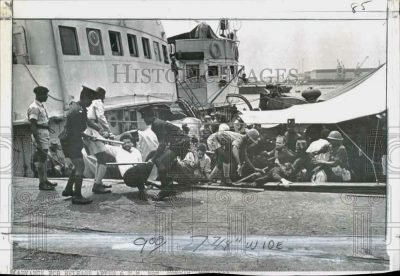
The previously mentioned background paints a honest photograph of the state of relations amongst Ghana and Guinea, and the political climate in Ghana. It is, therefore, not really hard to see how any one from Guinea may well finish up getting considered with suspicion.
The protagonist in this tale was a younger male by the identify of Salifa or Salifu. The regulation experiences named him as Mohammed Abdul Rahim Baba Salifa. The newspapers of the working day named him as Abdul Rahim Baba Salifu. For this piece, let us contact him Salifa.
Salifa was a fifteen-calendar year-previous schoolboy despatched to Guinea by his father in 1965 to analyze. Two decades later on, he ran away from his guardian. He run absent due to the fact he was being maltreated by his guardian. This was not out of the blue. He experienced earlier complained and prepared about the maltreatment he endured at the hands of his Guinean guardian – Dr Oury. His father had letters to show. There was, therefore, an founded pattern of abuse and mistreatment. So, he chose to flee.
He did not arrive to Ghana specifically. His 1st halt was Sierra Leone where by he asked the Ghanaian High Commissioner to support him return to his dad and mom in Ghana. He acquired the assistance he asked for. But not in the way he anticipated. He arrived in Ghana in June 1967. But when he touched down, he was arrested by the police and detained at the Ussher Fort Prison. He was not charged with any prison offence. He was just imprisoned. He was household but could not get property. The legislation report did not give any rationale for his arrest. Neither did the newspapers. It was commonly rumoured and thought that he was getting held only due to the fact he had arrived from Guinea. Others rumoured that he may well have been an agent of the Nkrumah sent to provide some messages to Nkrumah loyalists in Ghana.
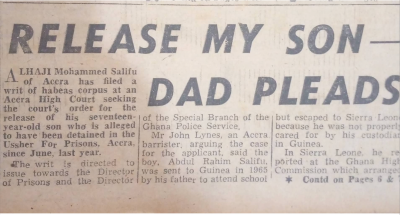 With his son at the Ussher Fort jail, his father attempted to do the incredibly all-natural issue: get his son out of jail. A yr right after Salifa’s detention (i.e., in June 1968), his father engaged a lawyer to compel the jail authorities to produce his son. A day was scheduled for the hearing. The Director of Prisons showed up. He had a decree signed by the Chairman of the Countrywide Liberation Council supposedly authorizing the arrest and detention of Salifa.
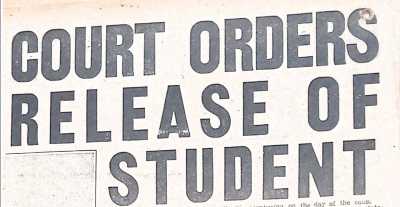 Salifa’s attorney challenged the validity of the decree issued by Normal Ankrah on the grounds that the decree was undated and not gazetted. Salifa’s law firm, John Lynes an Australian who experienced come to settle in Ghana and would at some point be deported, argued that the decree did not point out Salifa’s identify and hence it could not have applied to him. The figured out Significant Courtroom choose, Anterkyi J agreed with Salifa’s attorney and concluded that the decree authorizing the arrest and detention of Salifa was faulty and not compliant with the National Liberation Council’s individual proclamation. On that foundation, Salifa was unveiled.
But not for prolonged.
He was immediately re-arrested and introduced in advance of a different court. The first scenario was managed by Mr. K. Gyeke-Darko, a Principal Condition Attorney, who was well-known for prosecuting numerous coup plot trials. In the re-arrest proceedings, the Lawyer-Normal, Victor Owusu, and the Director for Public Prosecutions were in courtroom. The presence of the Legal professional-Typical and the Director for Community Prosecutions sums up the importance the NLC placed on this scenario.
Mr. Victor Owusu, as quoted in the 11th July 1968 Day by day Graphic, argued that the NLC federal government had unrestricted powers and 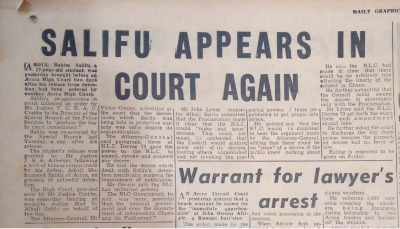 was “more powerful than the colonial govt and even the Government of independent Ghana and its Parliament”. Long tale brief, the NLC could not whichever it wanted to do, which includes arresting a seventeen-12 months-previous boy with out charge and lawful basis. The second court, presided above by Justice V.C.R.A.C Crabbe upheld the validity of the same detention purchase, and Salifa was behind bars once again. And this is in which the story finishes.
We only get an perception into Salifa’s thinking in a letter he wrote to his father. In his individual words and phrases he writes:
“Please, father, I will like you to know that when I was coming I reported myself to the Ghana High Commissioner in Sierra Leone that I am a seventeen-yr aged pupil who has been to Guinea in 1965 October (i.e. during the previous govt) and wished to arrive back again to Ghana and stay with my mom and dad, where by I will be capable to continue on my scientific tests. Properly, this gentleman (the Large Commissioner) gave me a ticket, ready my travelling certification and assisted me to embark into the plane for Ghana – with all my loyalty I am arrested.
Almost everything is crystal clear, I imagine, that if I ended up coming to do a little something in opposition to the govt I would not have passed by the Ghana Large Commissioner in Sierra Leone, but, as I stated, I am destined to be arrested. So, leave every little thing to God, father.
Please, when you obtain a letter from Oury stating that I have run away, take that letter to the Specific Branch (C.I.D.) with my letters which tell you that I am in jail in Ghana, so you have come to beg them torelease me mainly because I am harmless and I am a scholar, I am not fascinated in politics.”
Captured in the above letter is a complicated and conflicting established of feelings. Salifa asserts his innocence, arrives to conditions with his circumstances, makes an attempt to console the father, and somewhere in there wishes that his guardian in Guinea Dr. Oury will produce to the Ghanaian authorities to corroborate his story and ideally get him released.
Not a great deal is regarded of the fate of Salifa. Did he die? Did he survive the turbulent durations in incarceration? How prolonged was he there? Was he inevitably launched? Did he eventually get to know the expenses levelled against him? What type of daily life did he stay afterwards? It is difficult to tell. It has been earlier 50 % of a century considering that the situations explained in this piece took put. And unfortunately, Salifa’s story is however ready to be informed – in total.
***: I would like to thank Mr. Fui Tsikata of Reindorf Chambers for his feelings and perception on the subject matter. Also, my gratitude goes to Oliver Barker Vormawor and Ama Asare Korang for examining before drafts of this piece.
[1] [1968] GLR 630
[2]Keesing’s modern day archives, March 12-19, pg. (21275) http://web.stanford.edu/team/tomzgroup/pmwiki/uploads/1408-1966-Keesings-a-EYJ.pdf
[3] Ibid
[4] Ibid


